‘Lost In Thought’ Chapter two – The Brainchild
Richard Trescerrick glanced across at his old friend Seb Morley, the only one here he really trusted, then turned back to the computer and entered the numbers. Morley shielded him, making sure no one else in the lab could see.
“I’ll tell no one,” Richard said. “Not even you. Not yet. Not until I’m sure about Dubois. I don’t trust the man. Never have.”
“You’re sure about this algorithm? I don’t want to face a firing squad if you’re not certain.”
“Don’t worry. It’s all in the maths.” Richard gave Morley a grim smile. Years of work, decades of research had led him here, to the final piece, the algorithm that solved the feedback loop conundrum. The formula that made the Brainscape safe. “But there’ll be no firing squad for you. It’s my formula. I take the first hit.”
 Richard made the final adjustments to the neuro-signal processor, then changed the settings so they couldn’t be re-used. Or decoded. No one was getting this formula until Richard had answers.
He would face death inside the game. If it all went right, if the algorithm worked, he would wake up, alive and unharmed, his heart unshaken, his sanity intact, his mind alert and undamaged.
“If this works,” he said, “we’re ready.”
“We go public?”
“Finally. We’ll take this invention to the world.”
Richard pointed towards the medical beds on the other side of the lab, built in the basement of the manor house company headquarters. Above each bed, a skull-shaped tangle of metals and wires.
“It’s time,” he said, and brushed the nurse away. “I don’t need the tests every time. I know my own invention.” He lay down on one of the beds and fitted the Brainscape helmet to his head.
“The usual,” he told the assistant. “The World War Two scenario.” He glanced across at Morley on the next bed and nodded. The two men had created this game to test the potential of the device. An immersive role-play set in Nazi occupied London, involving spies and deceit and double-dealing. This time, though, Richard would take the game to its logical extreme. “Safeties off,” he said. “They’re no longer needed.”
In truth, the safeties had never worked. One dead colleague, another insane, a third in a coma, could testify to that. Now things were different. This time, Richard would battle the forces of darkness inside the game. He would offer himself as a sacrifice, put his life on the line. His life’s work would be vindicated. He would prove his invention was finally safe. [continue reading…]
Chapter one of ‘Lost In Thought’
Luke Trescerrick sat on a barstool in the public bar of The Shipwrecker’s Arms studying the whisky bottles, wondering if it was too early for a shot of Islay malt. He re-read the solicitor’s letter that arrived in the morning post and crushed it in his fist, thoughts percolating, dark and bitter.
The smell of the fishing nets drying on the harbour wall drifted through the open window and mingled with the scent of sandwiches and strong Cornish ale.
Pub landlord Vic Butler put a pint of beer on the bar in front of Luke. “Bad news?”
“Eviction notice.”
“The cottage? Your father?”
“His lawyers.”
“I thought it was yours. Your mother said…”
Luke’s fingers twisted in knots as he throttled the crumpled letter. “Nothing about that, in her will.”
Vic turned away from the bar, hands trembling as he dried a glass.
“This is it.” Luke took a long swig of beer. “I’ll be gone within the month.”
Vic leaned on the bar, close to Luke. “Go see your father, talk it over. Families shouldn’t fight.”
“It’s all mine ever does.”
“Think of Daniel. Do it for the boy.” [continue reading…]
So scientists have discovered that people who read a lot of fiction and become emotionally involved with the characters actually learn to become more ’empathic’ – by which they mean caring and compassionate.
Well…. duh!
Another case of scientists finally waking up and noticing what’s bleeding obvious. That’s a little unfair. I know science can’t assume common sense is right, because sometimes it isn’t. And there’s never any harm in having some hard evidence and actual research data. But really… People get good at the things they practice. Do something a lot and the brain makes more room for that activity. Get emotionally involved with the suffering of others on a daily basis, and sure enough, the brain responds, learns how to do that.
Of course, the scary side of this is the amount of cold, heartless violence there is in much of our society’s fictional narratives. Because the reverse has to be true. If we can treat the death of any character, even the ‘bad guy,’ as meaningless and trivial, then we’ll be laying down pathways for that too.
You can read the full research paper here.
Or an NBC report on the findings here.
My prehistoric fiction novel ‘The Dry Lands’ is now available as an epub version in several outlets, including Gumroad. It’s also on Kobo. And available through Smashwords. It should soon appear on the Apple iBooks store and Barnes & Noble as well. And others too numerous to mention.
I still intend to write a sequel, by the way. But no news yet on when I’m going to start.
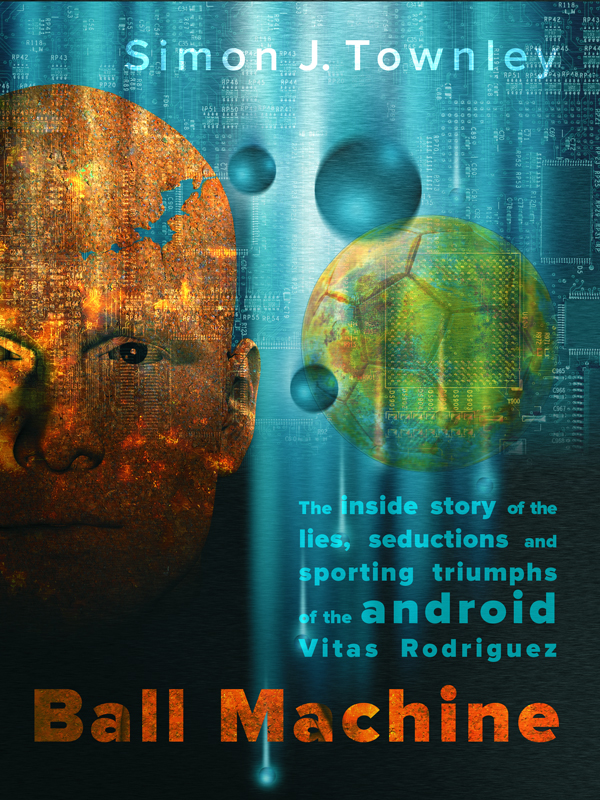
Chapter four of ‘Ball Machine’
In the inner sanctum of the programer’s den, Rosa shifted uncomfortably on the simple wooden seat. Tony and Dany both had thousand dollar chairs, with body curves and aerodynamic back supports, cushioned and adjustable arm rests, bulging neck braces and a sophisticated tilt-back action. These were chairs for men who spent twelves hours a day staring at computer screens. Each chair had an owner, their presence still penetrating the tough wool cushioning even when their bodies had stumbled forth in search of sleep or pizza. The chairs held an aura, a force field which kept strangers and interlopers at bay. Tony slid over on his own luxury chair, gliding like an ice skater across the wooden floor. He pointed to a corner where Rosa could fetch a wooden seat, like a set of stocks, designed to be uncomfortable.
Here, in this place, she was low status, not a programmer, not one of the elite.
The room was dingy. Wisps of daylight filtered around the dark blinds over the windows, but barely enough to disturb the ghostly glow of LCD screens.
Rosa took in the scene, the detritus of poor nutrition scattered across desks and bulging from waste paper baskets, and felt immense relief that she had pursued a career in medicine.
Tony was the man in charge, the man with his fingers on the keyboard. Dany was supervising the programming, while Rosa was there, in theory at least, to make the decisions. In practice, she was the client, there to create a wish list, while the boys found ways around the problems she threw at them. [continue reading…]
The Dry Lands is now available to buy as a epub version (compatible with most ereaders other than the kindle) at Gumroad.
The kindle version is available on Amazon. (UK version here.)
Chapter three of ‘Ball Machine’
Arizona, August 2014
Rosa was on her way to see her boys, the ones she actually trusted. Tony and Dany, older than most of the guys here, smarter too.
She tracked them down to the programmer’s lair, a room filled with screens, boxes, wires, gadgets, soldering irons and hard drives. One whole table was covered in empty drinks cartons and discarded food wrappers.
Tony didn’t look up from his screen, his fingers still bashing away at the keyboard. “When’s the match?”
When’s the striptease, that’s what he was really asking. It was still on everyone’s mind. At least it was getting things done around here.
Tony was eighteen stone, out of condition, and didn’t look he could run for a bus, never mind do a thousand sprints around a tennis court. He wasn’t what Rosa had in mind, when she thought of the ideal audience for a striptease.
“You tell me,” she said. “We’ve got the parts but they don’t work together. It’s not even a very good ball machine. Can’t we make something more…,” she waved a hand in the air, “more lifelike.” [continue reading…]
Chapter two of ‘Ball Machine’
Rosa spun the tennis racket in her hand, knees bent in a half crouch waiting for the ball to come over the net. Wearing the skimpy white shorts had been a mistake. She could sense Jedster’s eyes on her butt. The man had no subtlety. No class.
She bobbed her head at Tony to ask what was happening. Why the delay?
“Coming right up,” he called. He stepped away from the man-shaped machine on the other side of the net and pointed the remote control at its head. One arm swung into action, dropping the tennis ball to the ground. The other swung the racket. It missed, flailing at the ball with a whoosh of fresh air.
Over by the fence, a couple of the guys laughed. Rosa stood up straight and walked to the net, resting her racket on the top tape.
“Give it time,” Tony called out. He tapped at the control panel on the back of the robot’s head.
Rosa waited at the net, racket slung low by her ankles. The robot bent over, picked up the ball and threw it in the air. The racket whirled, made contact, and the ball flew towards her. Nonchalantly, she stuck out her racket and volleyed it away.
“Fifteen love,” someone shouted from the fence.
“It’s not even a very good ball machine,” Rosa said. [continue reading…]
Chapter one of ‘Ball Machine’
Arizona, May 2014
Half way down the second bottle of vodka, Rosalita Rodriguez had an idea. She looked at the others, a grin on her face, wondering how they would respond. It might work. They could do this.
“A robot,” she said.
The guys turned to look at her, their soupy eyes lingering a little too long. Their expressions, puzzled. Their demeanour, drunk.
Saturday night, and there was nothing happening outside of booze, poker and yelling at the Arizona desert. Fifty miles to the nearest town, nothing but run-down houses and a store. A hundred and fifty miles to the nearest place with a bar, anything that even smelt like nightlife.
“We build a robot,” she said. “It’s something to do.”
They were geeks, engineers, scientists. The best of the best. Smart and creative and ahead of every curve. Yet here they were, stuck in the middle of the desert, spending Saturday night watching reruns of sci-fi flicks and flipping corn chips around the canteen.
“Think of it as a hobby, something for time off.” Her gaze scoured the room, hunting for agreement.
“Sounds like hard work,” Jedster said, never taking his eyes off the first person shooter game on his tablet.
“We’ll pool what we can do,” she said. “Artificial intelligence. Robotic arms. Synthetic skin. We’ve got organic body parts growing in the med labs. Not a robot, we’ll make an android. See how far we can get. See how good we can make it.”
“No money in the budget,” Tony said. His eyes loitered behind a thicket of black, bushy eyebrows. At thirty, he was three years older than Rosa. It was ancient, for this place. “No time set aside for it. No lab time, no conference time.” [continue reading…]
‘Ball Machine’ – Prologue: Time Stops
Moscow, July, 2018
Time slowed. The weight of the world was on his shoulders. Relativity had kicked in.
Vitas Rodriguez accelerated past the Russian midfielders into open space. Seconds to go before time was up and the lottery was drawn. A penalty shoot out to decide the World Cup final. 
Vitas watched Alonso jink past a defender. The young winger lifted the ball over the Russian goalkeeper with a flick of his foot. As he hurdled the goalie, Alonso’s feet flailed in the air.
The final minute of injury time, an empty goal. The world held its breath. It all came down to this. Alonso must score.
Vitas heard a cry from the side-lines, a woman’s voice cut through the noise. Was it her? Did she call his name?
In front of him, Vitas saw Alonso stumble. The winger stuck out a boot, and the ball flew towards the open goal. Alonso must score.
Vitas kept running. Instinct. Get there, be there, pull Alonso to his feet, hold his hand high in triumph. It would be all right, the world would understand, forgive them in the end, if the winner came from flesh and blood, skin and bone. Alonso was the hero. Alonso must score.
Vitas sensed time kick and lurch as if its engine tugged against a hand brake. He noticed the sharp taste of metal in his mouth as the ball hit the post.
It rebounded back across the penalty area and rolled towards him. All he had to do was kick it.
At that moment, time stopped.
One second it was there, then… gone.
In the dug-out, a gangster held a gun to Rosa’s head.
Pete had vaporised, living on the proceeds, staying hidden.
In the stands, a billionaire had Natalya twisted around his fingers. The woman who would never love him.
In a forest monastery in the Thai mountains, a group of monks leapt to their feet, screamed at the borrowed television and howled for liberation.
Time hung motionless as eighty thousand people watched, transfixed. Around the world, billions of pairs of eyes focused on Vitas, urging the underdog to victory while praying he would fail.
Time stopped. None of this mattered, not the glory, the billions of dollars, or the economies of entire nations decided by a single step. Or stumble. Or kick.
History in the making, his future in the balance.
Time flashed before his eyes. All illusion.
How did it come to this?


 Richard made the final adjustments to the neuro-signal processor, then changed the settings so they couldn’t be re-used. Or decoded. No one was getting this formula until Richard had answers.